On 16 September 2026, ISO published the sixth edition of ISO 9001 and the 2015 edition began its countdown. This is what changed, what your auditor will now ask for, and how the transition works in practice.
More than a million organisations hold ISO 9001 certification, and almost all of them now hold a certificate against a superseded edition. That sounds alarming and is not: certificates issued to ISO 9001:2015 remain valid, and there is a transition window to move across. But the clock started on 16 September 2026, and it runs on audit cycles rather than on calendar convenience.
This article walks through the revision the way a certification body reads it — requirement by requirement, with an honest view of where evidence will be tested.
Quick Answers
- What is ISO 9001:2026? The sixth edition of the quality management systems standard, published 16 September 2026, replacing ISO 9001:2015.
- How big is the change? Moderate. The Harmonized Structure, process approach and PDCA are unchanged. Roughly four areas carry real audit consequence.
- Is my certificate still valid? Yes, throughout the transition window.
- How long do I have? A three-year window is expected, with the precise deadline set by the IAF communiqué. Confirm the applicable date with your certification body.
- When can I be audited to the new edition? Once your certification body’s accreditation has been extended to ISO 9001:2026.
How the ISO 9001:2026 Revision Came About
The revision was developed by ISO/TC 176/SC 2 over roughly three years. ISO 9000:2026, which carries the vocabulary the standard depends on, was published in May 2026. The Draft International Standard circulated in August 2025, the Final Draft International Standard in July 2026, and publication followed on 16 September 2026.
Three drivers shaped the content. The Harmonized Structure that aligns ISO 9001 with ISO 14001, ISO 45001 and ISO 27001 had been updated, and ISO 9001 needed to catch up. The climate change amendment issued across the management system standards in 2024 needed to be absorbed into the running text. And feedback from the certification and audit community pointed consistently at the same weakness: systems that conformed on paper while the behaviour underneath them did not follow.
Four ISO 9001:2026 Changes That Will Affect Your Audit
Most of the revision is drafting improvement and terminology alignment. Four things are different in a way that changes what evidence looks like.
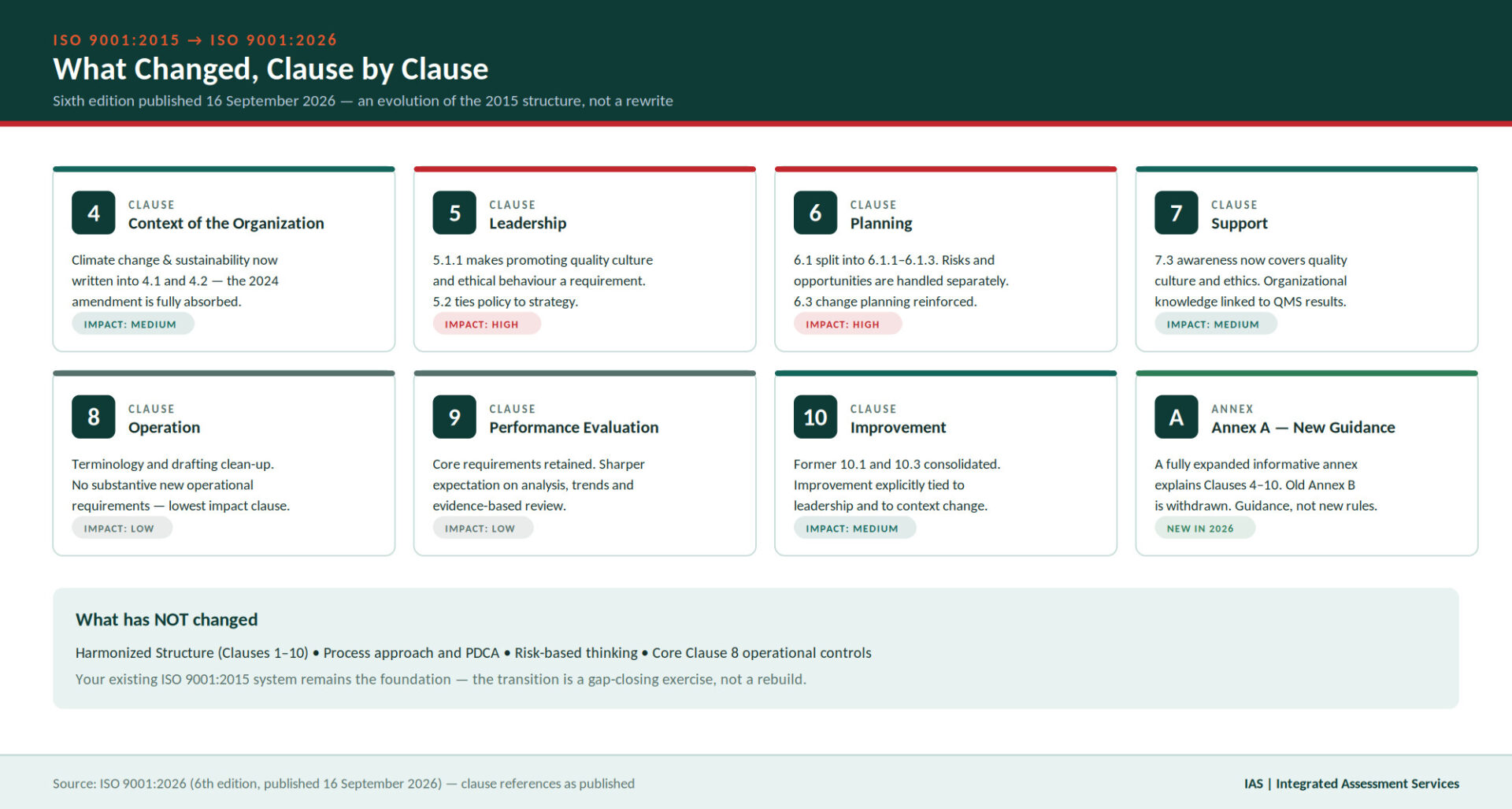
| Clause | What changed | What the auditor will look for |
|---|---|---|
| 5.1.1 | Top management must promote a quality culture and ethical behaviour | Leadership communications, an ethics or conduct policy linked to the QMS, how quality-versus-delivery conflicts are resolved, culture discussed in management review |
| 6.1 | Restructured to separate risks from opportunities | Two distinct planning streams, with a populated and live opportunity side, and evaluation of the effectiveness of both |
| 4.1 / 4.2 | Climate change permanently integrated into context | A recorded determination of whether climate change is a relevant issue, and whether interested parties have related requirements |
| 7.3 | Awareness extended to quality culture and ethical behaviour | People at all levels able to speak credibly about it, not only induction records showing it was covered |
ISO 9001:2026 Clause-by-Clause Walkthrough
Clause 3 — Terms and Definitions
ISO 9001:2026 brings the relevant quality management terms into the standard itself, aligned with the Harmonized Structure and ISO 9000:2026, which reduces the dependence on holding a second document to interpret the first.
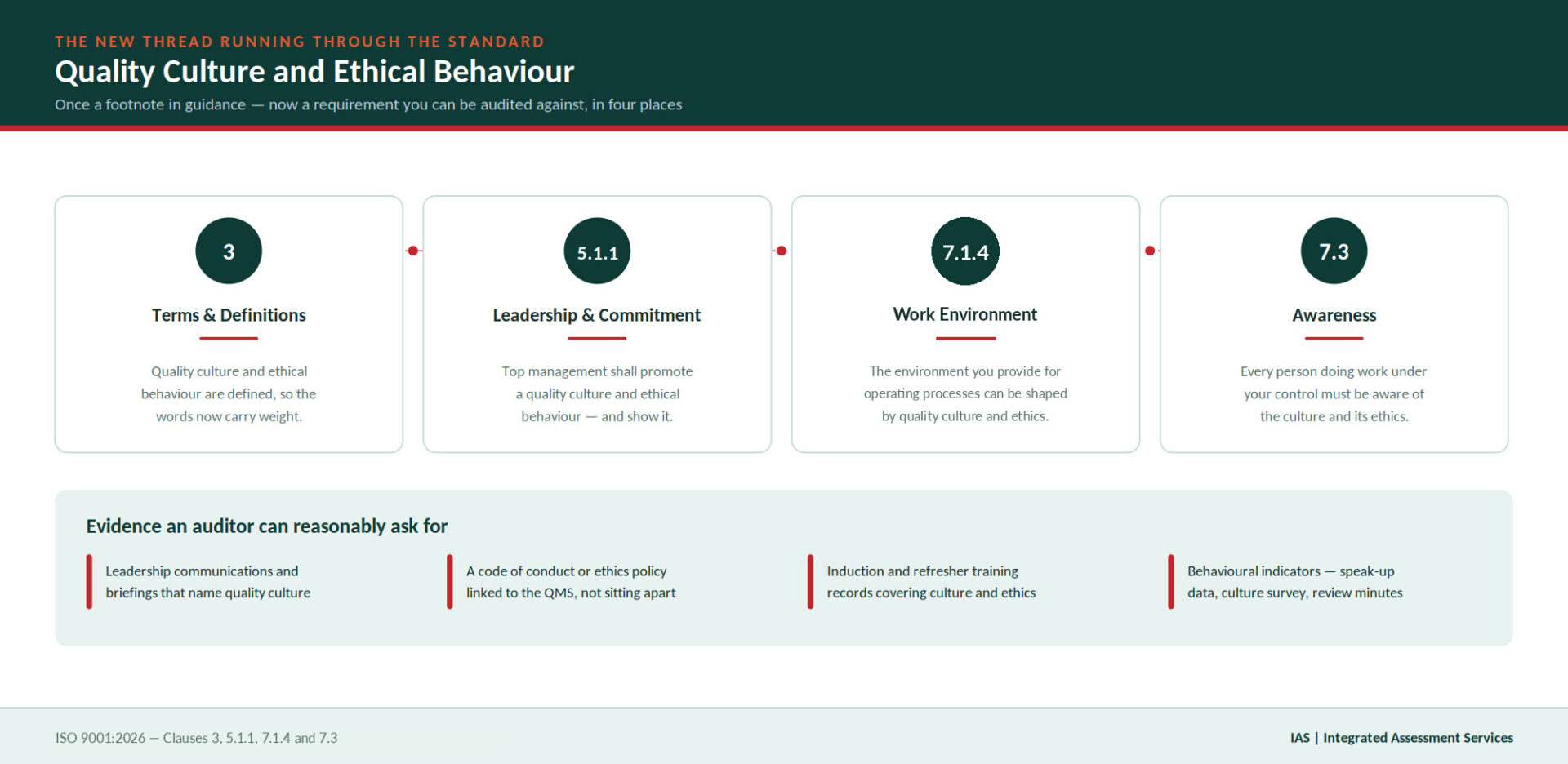
The definitions to note are quality culture and ethical behaviour. They are not decorative. A defined term in Clause 3 becomes an auditable concept wherever it is used, and both are used in requirement clauses.
Clause 4 — Context of the Organization
The climate change amendment of 2024 is now part of the standard rather than an addendum to it. Clause 4.1 requires the organisation to determine whether climate change is a relevant issue in its context; Clause 4.2 recognises that interested parties may have climate-related requirements.
Read the requirement precisely. It asks for a determination, not for a decarbonisation programme. An organisation that considers the question and concludes climate change is not a relevant issue to its ability to deliver conforming products and services is conforming — provided the conclusion is reasoned and recorded. A blank space where the consideration should be is the nonconformity.
Clauses 4.3 and 4.4 see clarified drafting. Scope statements and process interaction maps that worked under the 2015 edition continue to work.
Clause 5 — Leadership
Clause 5.1.1 adds the promotion of a quality culture and ethical behaviour to top management’s demonstrable commitments. This is the change with the longest lead time, because it is the only one that cannot be closed by writing something.
Clause 5.2 raises the bar on the quality policy: it must take account of the organisation’s context and support its strategic direction. Generic policy statements — the kind that could be lifted from one organisation and pasted into another without anyone noticing — do not meet that test comfortably.
Clause 5.3 on roles, responsibilities and authorities is substantively unchanged.
Clause 6 — Planning
The structural headline of the revision sits here.
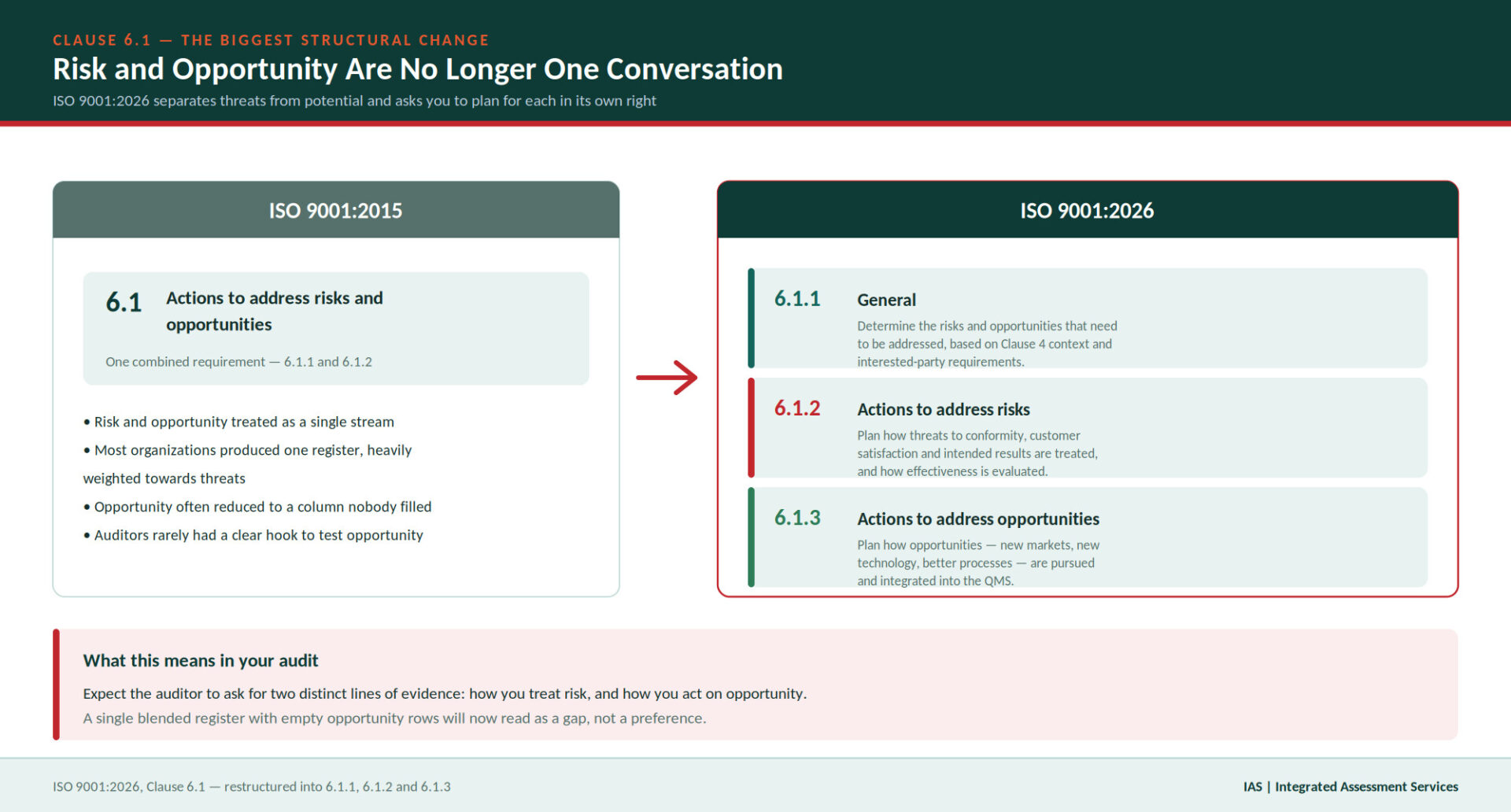
ISO 9001:2015 addressed risks and opportunities as one requirement. In practice the two are not symmetrical activities — treating a threat and pursuing an opportunity call for different thinking, different owners and different measures of success — and the combined requirement produced registers dominated by threats, with opportunity treated as an afterthought.
ISO 9001:2026 restructures Clause 6.1 into sub-clauses that separate the determination of risks and opportunities from the actions planned for each: a general requirement, then actions to address risks, then actions to address opportunities. Annex A guidance on this clause has been expanded substantially.
From an audit standpoint, this changes the question. It is no longer sufficient to produce a register and show that it is reviewed. The auditor will look for evidence that opportunities have been determined, that action has been planned and taken on at least some of them, and that the effectiveness of those actions has been evaluated — the same discipline that has always been applied to risk.
Clause 6.2 retains the requirements for quality objectives, with a firmer link to strategic direction. Clause 6.3, planning of changes, is reinforced: changes to the QMS must be planned, communicated, monitored, evaluated and reviewed so that they support intended results. Organisations that have been through an ERP rollout, a site move, an acquisition or a leadership change since their last audit should expect this clause to be tested against those events.
Clause 7 — Support
Clause 7 is restructured, with two changes worth planning for.
Clause 7.1.6, organizational knowledge, is expanded and explicitly connected to achieving the intended results of the QMS. Where many organisations have satisfied this clause with a reference to training records and experienced staff, the revision points towards identifying the knowledge processes actually depend on, where it resides, and how it is maintained when people move on. In sectors facing retirement of skilled personnel, this deserves more than a paragraph.
Clause 7.3, awareness, now requires that persons doing work under the organisation’s control are aware of the organisation’s quality culture and ethical behaviour, alongside the existing awareness requirements. Awareness has always been verified by conversation rather than by attendance sheets, and that method is well suited to testing this addition.
Clauses 7.2, 7.4 and 7.5 — competence, communication and documented information — see clarified wording without material expansion.
Clause 8 — Operation
The largest clause in the standard is the least affected. Clause 8 receives terminology alignment and drafting improvements without substantive new requirements. Design and development controls, control of externally provided processes, production and service provision, identification and traceability, release and control of nonconforming outputs all carry forward.
For certificate holders this is the practical good news: the operational core of your system does not need to be reopened.
Clause 9 — Performance Evaluation
Requirements for monitoring and measurement, internal audit and management review are retained. The revision reinforces the expectation that analysis and evaluation produce decisions rather than reports.
Two items need action before a transition audit. Internal audit criteria must be updated to the 2026 clause set, and internal auditors need to be competent to audit the new requirements — which is where ISO 9001 internal auditor training earns its place in the plan. Management review inputs should cover quality culture and the effectiveness of actions taken on opportunities as well as risks.
Clause 10 — Improvement
Clause 10 is consolidated, bringing what was previously separated across 10.1 and 10.3 into a single, clearer treatment of continual improvement. The guidance sets out that improvement may be triggered by changes in context, by risks and opportunities, and by the adoption of new technology, and leadership’s role in supporting improvement is made explicit — linking Clause 10 back to Clause 5.
Clause 10.2, nonconformity and corrective action, is unchanged in substance.
Annex A — Expanded Guidance
The single largest addition to the document is informative rather than normative. Annex A has been expanded into clause-by-clause guidance for Clauses 4 to 10, and the former Annex B has been withdrawn with its content consolidated. Annex A creates no new obligations, but it is where interpretation questions on culture, opportunity and change planning should be taken first.
What Will Your Certification Body Do?
Transition is a coordinated process, and the sequence matters. It follows the same IAS certification process and ISO audit procedure you already know, with one extra step at the front.
- Accreditation bodies extend certification bodies’ scopes to ISO 9001:2026. Until that is complete, no accredited certificate can be issued against the new edition — IAS’s own accreditation is the one that matters for your certificate.
- Certification bodies transition their auditors, updating competence records and audit criteria for the new requirements.
- Certified organisations complete their own implementation and internal audit, then undergo transition — normally at a scheduled surveillance or recertification audit, with additional audit time allocated.
- Certificates are reissued to ISO 9001:2026 once any findings are closed. The certificate expiry date usually remains tied to the existing certification cycle.
The timing trap. Transition audits cluster heavily in the final year of every transition window. In the 2015 transition, organisations that left booking until the last months faced limited availability and, in some cases, lapsed certification.
If your recertification audit falls in 2028, that is your natural transition point — and planning should start well before it.
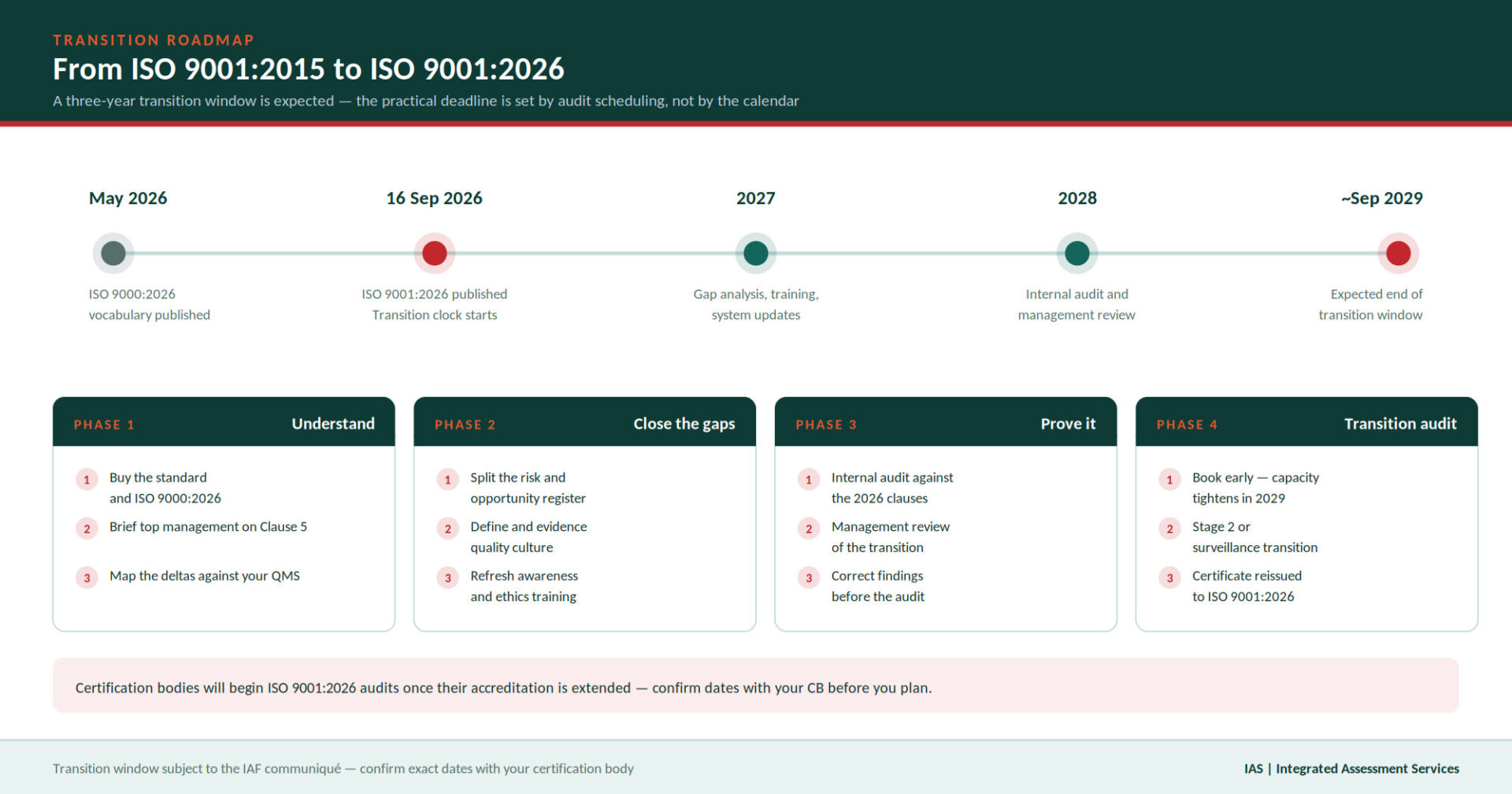
A Realistic ISO 9001:2026 Transition Plan
- Get the standard. Work from ISO 9001:2026 and ISO 9000:2026 directly, and read Annex A alongside the requirements.
- Brief top management first. Clause 5 is the only part of this revision that cannot be delegated to the quality function.
- Run a clause-by-clause gap analysis, prioritising gaps by the time they take to close rather than by the effort involved.
- Split risk and opportunity, and give the opportunity side real content and real owners.
- Define your quality culture in your own language, and decide what evidence of it looks like in your organisation.
- Update awareness training and deliver it, then verify by conversation rather than by signature.
- Strengthen change planning under Clause 6.3 for the changes your organisation is actually going through.
- Audit internally against the 2026 clauses, close findings, and let the evidence accumulate over a full cycle.
- Book your transition audit early, with a buffer for any findings that need closure.
Auditors who will be carrying out second- and third-party audits against the new clause set can build on ISO 9001 lead auditor training.
Integrated Management Systems and Sector Schemes
Organisations running ISO 9001 alongside ISO 14001, ISO 45001 or ISO 27001 should treat this as an opportunity rather than a disruption: the Harmonized Structure is retained, and alignment across the standards is improved. Context, leadership, planning and improvement can be transitioned once across the integrated system rather than three times in parallel — and if you are also moving environmental systems across, the ISO 14001:2026 changes follow the same pattern.
Automotive suppliers certified to IATF 16949 should watch for IATF’s own position on the revised ISO 9001, since IATF 16949 is applied in conjunction with ISO 9001 and sector transition arrangements are issued separately. Organisations working to sector schemes built on ISO 9001 should confirm the same with their scheme owner.
Transition to ISO 9001:2026 with IAS
IAS (Integrated Assessment Services) is an accredited certification body operating across the USA, the UAE, India, Australia, Malaysia, Singapore, Indonesia and Africa, providing ISO 9001 certification and certification to the wider family of management system standards.
- ISO 9001:2026 transition audits carried out at your scheduled surveillance or recertification audit wherever possible.
- New certifications directly to ISO 9001:2026 for organisations starting now — see how to get ISO 9001 certification.
- Integrated audits across ISO 9001, ISO 14001, ISO 45001 and ISO 27001, transitioning the shared clauses once.
- Pre-transition gap assessment against the 2026 requirements, so that findings surface before the certification audit rather than during it.
Plan your transition audit. Contact the IAS team to confirm transition timing for your certification cycle and to schedule your ISO 9001:2026 audit while capacity is open.
This article provides a general summary of the changes introduced by ISO 9001:2026. Clause references reflect the standard as published. Organisations should work from their own licensed copy of ISO 9001:2026 and confirm transition dates and arrangements with their certification body.
Frequently Asked Questions
How much extra audit time should we expect for the transition?
It depends on the size and complexity of your system and on how well prepared you are. Your certification body will confirm the additional duration when the audit is planned.
What happens if we miss the ISO 9001:2026 transition deadline?
Certification against the withdrawn edition ceases to be valid, and restoring it generally requires a new initial certification cycle rather than a transition audit.
Can we transition to ISO 9001:2026 early?
Yes. Once your certification body can audit to the new edition and your own system is ready, there is no reason to wait — and transitioning early keeps you clear of the capacity squeeze in the final year of the window.
Is ISO 9001:2026 harder to pass than ISO 9001:2015?
Not in volume — most of the standard, including all of Clause 8, carries over. The difference is in the kind of evidence: culture, opportunity planning and awareness are shown through what people do and say over time, so they reward organisations that start early rather than those that prepare hard in the final month.
Does a multi-site certificate transition all of its sites together?
Yes. A multi-site certificate covers one management system, so it is transitioned as a whole rather than site by site. Your certification body will plan which sites the transition audit samples and how much additional time is needed, and every site in scope needs to be ready by then.
What is the difference between a transition audit and a recertification audit?
A recertification audit re-assesses your whole system at the end of the three-year certification cycle. A transition audit adds assessment of the new ISO 9001:2026 requirements to an audit that is already due. When your recertification falls inside the transition window, the two are commonly combined into one visit.