About GMP and cGMP Internal Auditor Training
GMP and cGMP internal auditor training prepares quality, production, laboratory and engineering staff to audit their own manufacturing operation against Good Manufacturing Practice requirements and against whatever the company’s own documentation commits it to. Good Manufacturing Practice covers the quality and manufacturing practices required in regulated industries such as pharmaceuticals and medical devices. GMP is a regulatory practice, not an ISO standard.
Training is delivered at two levels:
Delivered by IAS with its sister organisation EAS, the internal auditor course leads to a course-completion certificate. Where what you need is independent assessment of a manufacturing site rather than training for its staff, GMP certification sets out that route.
What the “Current” in cGMP Adds
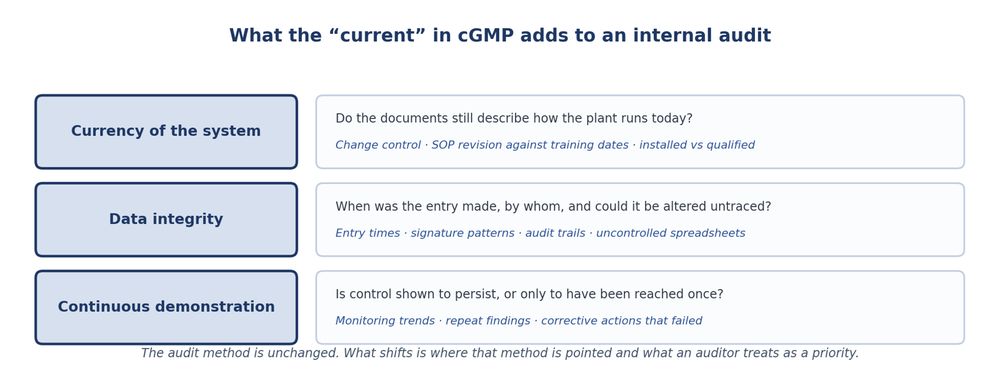
The audit method is identical whichever term appears on the requirement. Define scope and criteria, prepare a checklist, sample records, observe operations, interview the people doing the work, gather referenced evidence, classify findings, report, and verify corrective action. Where the standard is specifically cGMP, three things change in what the auditor is expected to look for — and those three account for a disproportionate share of findings. The difference is examined further in cGMP vs GMP: what “current” actually changes.
Currency of the system
GMP asks whether adequate controls exist. cGMP asks whether they still describe how the plant runs today. That single word turns several routine audit questions into comparisons across time. Is this SOP the version the operator is following? Was this parameter within the validated range when the batch ran? Did the change made in March reach validation and training?
An auditor working to cGMP therefore spends proportionally more time on change control, on document revision dates against training dates, and on comparing what is installed against what the qualification report describes. These are not different techniques. They are the same evidence discipline pointed at the gap between the documented state and the present one.
Data integrity
The expectation that records be attributable, legible, contemporaneous, original and accurate is not unique to cGMP, but it carries particular weight there, and it changes what an auditor examines. Rather than confirming that records are complete, the auditor asks when each entry was made, by whom, and whether it could have been altered without trace. That directs attention to entry times, signature patterns, corrections, audit trails, user access and the uncontrolled spreadsheet doing a regulated calculation.
Continuous demonstration
cGMP treats compliance as a state that must be shown to persist, not a milestone that was reached. For the audit programme this means trend data matters as much as point results: environmental monitoring trends, deviation patterns, recurring findings, corrective actions that failed and were reissued. An auditor who examines only whether each individual result met its limit has not tested the thing cGMP is actually asking about.
Where GMP and cGMP Audits Diverge in Practice
| Audit area | Auditing to GMP | Additional emphasis under cGMP |
|---|---|---|
| Procedures | Adequate, approved, available | Version at the workstation matches the current register |
| Process parameters | Within specification | Within the range that was validated, and unchanged since |
| Records | Complete and signed | Contemporaneous, attributable, unaltered without trace |
| Equipment | Calibrated and maintained | Status verified at the time of use, linked to batches |
| Training | Delivered and recorded | Retriggered when the procedure was revised |
| Monitoring results | Within limits | Trended, with deterioration acted upon before the limit |
| Corrective action | Implemented | Verified effective after a period of normal operation |
| Change | Controlled | Traced outward into validation, training and documentation |
The right-hand column is not a separate audit. It is what an experienced auditor adds to each of the questions in the middle column, and it is what the training develops.
The Comparison That Opens Most Audits
One exercise expresses the cGMP emphasis better than any explanation, and it takes about twenty minutes.
Take a procedure that governs an active process and note its revision number and date. Go to the workstation and read the copy in use — same revision? Look at the training records for the people performing it — trained on that revision, and how soon after it was issued? Then pull three records completed since the revision date — do they reflect what the new version requires?
Four checks, one thread. Where all four line up, the system is current in that respect. Where the thread breaks, the auditor has a specific, evidenced finding and a clear picture of which system failed: document distribution, training linkage, or the change process that should have connected them.
What the Internal Auditor Course Covers
Objective
Enable participants to plan, conduct, report and follow up internal audits of GMP and cGMP quality systems, with particular competence in the currency, data integrity and trending emphases that cGMP carries.
Coverage
GMP and cGMP fundamentals and where they differ; the regulatory framework for pharmaceutical and medical-device manufacturing; premises and equipment; personnel and hygiene; documentation and records; production and process controls; quality control; and complaint and recall handling. On method: scope and criteria; planning and checklist development; sampling; document revision and training linkage; validated ranges and change control; contemporaneous records and data integrity; trend analysis; observation and interviewing; objective evidence; nonconformity classification; report writing; corrective action review and effectiveness verification; and auditor independence and conduct.
Learning outcomes
On completion, participants should be able to prepare and conduct an internal audit against defined criteria, test whether the documented system still describes current operation, gather referenced objective evidence, raise and word nonconformities, produce an audit report, and verify corrective actions. The written report is covered as well: a finding worded to hold up under challenge, and a recurring problem’s root cause found without naming anyone.
What an Internal Auditor Actually Does
Preparation
The work begins with reading: the relevant procedures, the last report, and whatever corrective actions are still open. It ends in a checklist that states what will be examined and how much of it.
On the day
You watch the activity take place for its own reasons rather than for the auditor’s, read the records that ought to describe it, and ask the people doing the work to explain what they do. Everything recorded carries a reference — the document and its revision, the batch, the equipment, the date — so that a finding can be checked without repeating the audit.
After the audit
Each finding is written and graded ahead of the closing meeting — the requirement first, then the evidence, then the distance between them — with no adjectives and no individual named. Afterwards the auditor reviews the corrective action against whether it would prevent recurrence, and verifies it with evidence drawn from the period after implementation.
Who Should Attend
| Participant | Relevance |
|---|---|
| QA officers and managers | Own the audit programme and the CAPA system |
| Quality system owners | Responsible for demonstrating the system stays current |
| Production supervisors | Change at line level is where currency is most often lost |
| QC and laboratory staff | Data integrity questions concentrate here |
| Validation and engineering | Qualification status and revalidation triggers |
| Documentation controllers | Revision, distribution and training linkage |
| Regulatory and compliance staff | Add practical audit method to requirements knowledge |
| Contract manufacturers | Client auditors apply exactly this emphasis |
Nobody is expected to arrive having audited before. Employees already working inside a manufacturing quality system apply the method fastest. Anyone approaching manufacturing quality without a background in it will get more from the course after completing a cGMP foundation course.
Prerequisites
There is no mandatory requirement for previous experience in quality management systems. Basic knowledge of GMP auditing is an advantage but is not assumed.
Skills the Course Develops
- Testing whether the documented system still describes the operation as it runs today
- Following a procedure revision through distribution, training and completed records
- Comparing running parameters against the validated range and the change history
- Examining records for contemporaneous completion rather than completeness alone
- Assessing audit trails, user access and uncontrolled calculation spreadsheets
- Reading monitoring data as a trend rather than a series of individual results
- Recognising recurring findings as evidence that a corrective action failed
- Recording objective evidence with references that survive challenge
- Wording findings as requirement, evidence and gap, against systems not people
- Verifying corrective action effectiveness after a period of normal operation
Duration and Delivery
The internal auditor course runs for one day as a lecture-based seminar combined with interactive exercises, conducted at your location or at the trainer’s offices. Four formats are available: classroom, live online with an instructor, self-paced, or run at your own premises. Duration and fees are confirmed in the same written quotation once participant numbers and the route are settled.
Where a company is training several people at once, the common pattern is to cover the method through online cGMP internal auditor training and then run the practical exercises together. Virtual cGMP training suits teams split across sites.
Why the Emphasis Matters Commercially
Customer auditors and certification bodies apply this emphasis whether or not the word cGMP appears in their checklist. They ask when a record was completed, not only whether it was. They compare the version at the workstation against the register. They look for the change that never reached validation.
A site whose own auditors work the same way finds those gaps first, which changes external audits from a source of surprises into a confirmation of what the site already knew. Attendees also gain the ability to build an internal audit programme on a unified framework, with hands-on guidance from auditors who have performed many assessments.
Training and Certification Are Different Things
| Internal auditor training | GMP or cGMP certification | |
|---|---|---|
| The subject | An individual employee’s capability | The organisation and its manufacturing site |
| Who carries it out | Your own trained staff, internally | An independent certification body |
| What exists at the end | A competent auditor and a training record | A certificate covering a defined scope |
| How it continues | Through the internal audit programme | Through surveillance and recertification |
A certified system is expected to audit itself, so the two support one another — but completing a course certifies no company, and holding a certificate produces no auditors. Background on the organisational route is set out in the IAS guide on how to get GMP certification.
How Do I Become a GMP Auditor?
Those who have worked in the field for five years or more and occupy a higher-level position can go on to become GMP auditors. The usual path starts with internal audits, building confidence through document reviews before leading full assessments.
How to Enrol
Tell us where the site is, what it manufactures and how many auditors you intend to develop, and IAS will propose a format and a date. Contact us for details, email enquiry@iascertification.com, or call +91 99625 90571.
Worth stating without ambiguity: IAS delivers training and certifies management systems. Permission to run a manufacturing facility, and permission to place a product on the market, rest with regulatory authorities alone.
GMP Training — Frequently Asked Questions
Is cGMP internal auditor training different from GMP internal auditor training?
What does "current" actually require an auditor to check?
Why does data integrity feature so heavily?
Do we need separate auditors for cGMP and GMP audits?
Does trend analysis require statistical training?
Can the course be delivered to a team across several sites?
Which GMP requirements does the course cover?
What do participants receive at the end?
Where This Course Is Delivered
IAS delivers this Lead Auditor course across India and online.